The Orthodox Christmas Celebration in Russia
Christmas in Russia falls on January 7 — nearly two weeks after the date most of the world associates with the holiday. For anyone building a relationship with a Russian woman, understanding why that date is different, and what the holiday actually looks like in practice, is genuinely useful. It’s also a good entry point for showing real curiosity about her culture rather than assuming everything maps onto Western traditions.
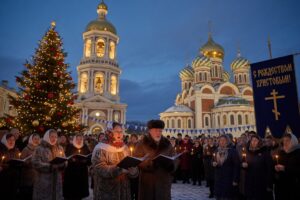
Here’s what’s worth knowing about Russian Orthodox Christmas traditions — the calendar history behind the date, the customs that shape the celebration, and the scale of how it’s observed across Russia and beyond.
Why Russian Christmas Falls on a Different Date
The date difference comes down to which calendar a church follows. The Catholic Church and most Protestant denominations use the Gregorian calendar, introduced by Pope Gregory XIII in 1582 to correct accumulated drift between the civil calendar and the astronomical year. The Russian Orthodox Church, along with several other Orthodox churches, has continued to follow the older Julian calendar for religious observances, even though Russia and other Orthodox-majority countries officially adopted the Gregorian calendar for civil purposes — in Russia’s case, not until the early 20th century.
The gap between the two calendars now sits at thirteen days, which is exactly why Orthodox Christmas lands on January 7 by the Gregorian count, even though it’s still December 25 according to the Julian calendar the church uses internally.
This isn’t unique to Russia. Christmas on January 7 is also observed by the Orthodox churches of Jerusalem, Serbia, and Georgia, by Eastern-rite Catholics such as Ukraine’s Greek Catholic Church, and by Protestant communities that still follow the Julian calendar for religious dates.
What the Lead-Up to Christmas Looks Like
Orthodox Christmas is preceded by a period of fasting known as Nativity Lent, which shapes behavior in the days leading up to the holiday. On Christmas Eve specifically, observant followers traditionally eat only kutia — wheat or other grain soaked and softened, eaten as a simple, symbolic meal before the full celebration begins.
One of the most distinctive customs is the rule that the Christmas Eve meal doesn’t begin until the first star appears in the night sky — a tradition tied symbolically to the Star of Bethlehem. Families wait together, sometimes literally watching the sky, before sitting down to eat.
How the Holiday Is Actually Celebrated
Once the fasting period ends, Russian Orthodox Christmas turns into a genuinely festive occasion — music, traditional games, and family gatherings that carry real warmth. It’s treated as a family holiday in the fullest sense, an occasion for closeness, sentimentality, and the exchange of good wishes.
Gift-giving is part of the tradition, though the gifts themselves — chocolates, sweets, small tokens — tend to matter less than what accompanies them. The genuine emphasis is on wishing someone health, happiness, and love for the year ahead. If you’re getting to know a Russian woman around this time of year, a heartfelt card or message carries real weight, and a small thoughtful gift on top of that is well within the spirit of the holiday.
The scale of religious observance is considerable. Moscow alone has more than 800 churches that hold Christmas services, and the Russian Orthodox Church oversees more than 29,000 churches worldwide. Christmas Mass on January 7 draws large crowds across the country, reflecting how central religious practice remains to the holiday even after decades of Soviet-era secularism.
A Good Topic for Genuine Conversation
If you want a window into how a Russian woman actually experiences this time of year, watching footage of Orthodox Christmas celebrations — widely available online — gives a much clearer picture than any written description. Seeing the customs in action makes it easier to ask specific, genuine questions: whether she exchanged gifts with her parents, what she traditionally eats on Christmas Eve, how her family marks the first star appearing.
It’s also worth keeping the season’s practical reality in mind. January in Russia is genuinely cold, and much of the holiday period is spent indoors with family rather than out and about. That’s part of why the holiday carries such a cozy, homebound character — the cold outside makes the warmth of the gathering indoors feel more deliberate and more valued.
Asking about these traditions with real curiosity — not as a script, but because you’re genuinely interested in understanding her world — tends to be one of the more meaningful things you can do early in a relationship with a Russian woman. It signals that you’re paying attention to who she actually is, not just the idea of her.