Celebrations and parties at Russia
Holidays reveal more about a culture than almost anything else. They show what a society chooses to remember, what it celebrates, and what it’s willing to set aside ordinary life for. Russia’s calendar is unusually rich in this respect — a blend of ancient pagan ritual, Orthodox Christian tradition, and Soviet-era commemoration that together produce one of the more layered holiday calendars in Europe.
This guide walks through the major Russian holidays and festival traditions across the year, what they actually involve, and where they came from.
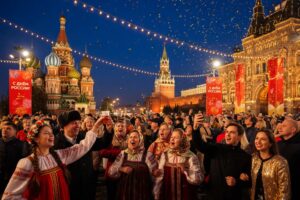
The most important celebrations and parties in Russia are the following ones:
-
- 1 and 2 January: The Russian New Year celebrations
- 7 January: Celebration of Orthodox Christmas
- 5 to 19 January: Feast of the Svyatki
- 13 January: “The Old” New Year party
- 25 January: Celebration of the day of St. Tatiana
- 23 January: Celebration of the day of the defender of the fatherland
- 14 February: Saint Valentine’s Day party (worldwide celebration)
- 8 March: International women’s Day celebration (a worldwide celebration)
- March: Celebration of Russian Carnival (the Carnival)
- 1 April: Celebration of the day of the innocents
- From April to May: Celebration of Orthodox Easter
- 1 May: Celebration of the feast of spring and labor
- 9 May: Victory day celebration (end of the second world)
- 12 June: Celebration of the day of the Declaration of the national sovereignty of the Russian Federation
- 22 June: The Festival of Ivan Cupala
- 7 November: Celebration of the day of reconciliation and concord
- 12 December: Celebration of the day of the Constitution of the Russian Federation
Feast of the Svyatki
Svyatki refers to the twelve days leading up to the Orthodox celebration of Christ’s baptism. During this period, the tradition calls for visiting sacred sites, donating to those in need, checking in on people with disabilities, and exchanging gifts with friends and family — a custom traced back to the three wise kings presenting gifts to Jesus on the Holy Night.
Despite its Christian framing today, Svyatki has deeply pagan roots. Fortune-telling and card-based divination were central to how young people traditionally spent these evenings, and night work was considered inadvisable — partly because of the belief that the souls of the dead returned to earth on the first day of the festival.
Specific rituals marked the period. Families would sprinkle fresh spring water through their homes to invite happiness. Peasant households would cover their floors with straw and bring livestock indoors to feed them bread, a practice believed to guarantee fertility for the animals in the year ahead.
Old New Year
Russia celebrates a second new year on the night of January 13 — a holdover from the old Russian calendar, under which this date once marked the actual turn of the year. Champagne is the traditional drink of choice, with each glass symbolically toasting both the joys and sorrows of the year just passed.
Historically, young people would visit neighboring households on this night, singing cheerful songs in exchange for sweets or small amounts of money — a custom not unlike caroling, carrying wishes of good fortune from house to house. They’d return home with both gifts and a sense of festive goodwill to share with their families.
Defender of the Fatherland Day
This holiday traces back to 1918 and the founding of the Red Army and Soviet Navy. Today it honors everyone who has served to defend Russia. The date — February 23 — marks the day the Soviet government declared a national mobilization under the banner “the socialist fatherland is in danger,” after refusing to honor the prior regime’s debts triggered hostility from creditor nations even as the civil war raged domestically.
The day has expanded over time into something closer to a general celebration of men, with women honoring the most important men in their lives — fathers, sons, brothers, partners — with gifts and gestures of appreciation. Military memorials across Russia, including those lining the Kremlin walls in Moscow, serve as focal points for commemoration. In 2006, Russia introduced the “Hero City” designation, honoring cities whose defenders showed particular courage during the Great Patriotic War. Across homes, schools, and workplaces nationwide, anyone who has served in the military receives recognition on this day.
Saint Valentine’s Day in Russia
Valentine’s Day has only relatively recently become a fixture in Russia, but it has settled in firmly. The holiday’s origins trace back roughly 1,800 years to Rome, where Emperor Claudius II — short on soldiers and blaming marriage for the shortfall — banned weddings outright. Bishop Valentine defied the ban and secretly married couples regardless. When Claudius discovered this, he had Valentine executed, and February 14 became forever associated with love in his memory.
Russian couples, particularly younger ones, have embraced the holiday as an opportunity to openly express affection — much as it functions anywhere else in the world.
International Women’s Day
Celebrated on March 8 worldwide, this holiday originated from the broader movement for women’s political, economic, and social equality. Russia’s first celebration took place in Saint Petersburg in 1913, and the day remains an official holiday in the country today.
What does the occasion actually call for? Recognition across every role a woman occupies — as a mother, a wife, and a professional in her own right. Tulip bouquets are the customary gift, given widely to women and girls across the country on this day.
The Feast of Spring and Labor
May 1 was designated International Workers’ Day by the Socialist International Congress in Paris in 1889, and during the Soviet era it became one of the most significant dates on the calendar — marked by parades filled with balloons and red flags moving through city avenues.
Today, the holiday continues primarily through Russia’s left-leaning political parties and trade unions, who use the occasion to advocate for workers’ rights and push for better wages and conditions.
Victory Day
Victory Day commemorates the Soviet Union’s defeat of Nazi Germany, and it remains one of the most emotionally significant dates on the Russian calendar. The celebration falls at the height of spring, when apple blossoms cover the trees and the season’s light fills the streets.
Red Square serves as the central venue. A military parade begins at 10 a.m., and the President lays a wreath at the Tomb of the Unknown Soldier. Russia lost more than 20 million people in the war — a scale of loss that shapes how seriously this day is observed. As the generation who lived through it grows smaller each year, the holiday increasingly functions as a transmission of memory: grandparents passing down both the weight of what happened and the hope that it never happens again.
Declaration of Sovereignty of the Russian Federation
One of the newer additions to the Russian calendar, this day marks June 12, 1990 — when the Declaration of National Sovereignty was approved, setting in motion the structural transformation toward a federal state. It marked the starting point for building a new civil and democratic society in which every citizen carries meaningful weight. The day is treated less as nostalgia and more as an acknowledgment of a specific turning point — neither idealizing the past nor discarding it.
Maslenitsa: The Russian Carnival
Maslenitsa is Russia’s pagan farewell to winter and welcome to spring, celebrated at the end of February or the start of March — a nod to the era when the Russian new year itself began in March. The week is filled with games, costume parties, and abundant food, most notably blini — round pancakes whose shape traditionally symbolized the sun god of pagan belief.
Maslenitsa is also the name given to a straw doll central to the festivities, dressed and paraded through the celebrations before being ceremonially burned or discarded at the week’s end, symbolizing winter’s departure.
Each of the seven days carries its own name and character: the first day welcomes the carnival’s arrival; the second kicks off the games, with young people in costume visiting homes and collecting sweets; the third is dedicated to indulging in sweets; the fourth, “Big Thursday,” is the most exuberant day of the week; the fifth involves family visits, traditionally to enjoy blini together; the sixth is for visiting parents and spending extended time in conversation; and the seventh closes the week as a day of forgiveness, clearing the way for Lent.
Day of the Innocents (April Fool’s Day)
The exact origins of this day are disputed — ancient Rome, India, and Ireland have all been credited — and nobody is entirely certain when the tradition arrived in Russia, though some trace it to the era of Peter the Great. It has never held official status as a holiday, but it’s widely observed regardless.
Russian literature from the late 18th century already contains references to April 1 pranks. Surveys suggest a majority of Russians are happy to play a joke on friends or colleagues on this day — including, occasionally, on people in serious positions of authority. Not every joke stays harmless; in April 2009, a group of students caused real damage to a Lenin monument in Saint Petersburg with an explosive prank that went further than intended. The card game “The Madman” is traditionally played on this day, and television programming often marks the occasion as well. The same date is celebrated in many Spanish-speaking countries on December 28, under the name Day of the Innocents.
The Feast of Ivan Kupala
One of Russia’s most significant pagan festivals, Ivan Kupala is tied to water, fire, and the natural world, and falls on June 22, aligned with the solstice. It’s a communal celebration by design — the tradition calls for broad participation rather than private observance.
At the heart of the festival is the symbolic union between Yarila and Mokoshi, representing heaven and earth, sun and moon, fire and water. The ritual centers on a burning wheel — symbolizing the masculine principle — rolling down a slope into water, which represents the feminine. A birch tree is selected as part of the ceremony, accompanied by a doll known as Koleda.
One of the festival’s best-known customs involves young women weaving wreaths and casting them into a river. If a wreath drifts with the current rather than washing up on the bank, tradition holds that the woman who threw it will marry soon. The fern also plays a symbolic role — according to legend, it blooms crimson only once a year, and a person who finds it flowering at night is said to be able to glimpse their future.
Day of Reconciliation and Concord
This day marks the anniversary of the events of November 7, when Lenin’s forces seized the Winter Palace — the moment that set in motion what would become known as the Great October Socialist Revolution. Rather than commemorating the revolution triumphantly, the modern holiday calls for something different: reconciliation, an invitation for the country, across class lines, to set aside historical grievances in favor of social unity.
Constitution Day of the Russian Federation
Celebrated on December 12, this day marks the 1993 adoption of Russia’s Basic Law — the foundational document establishing freedom, justice, equality, and political pluralism as core national values, while formally recognising and protecting the rights of Russian citizens.
What These Holidays Reveal
Taken together, Russia’s holiday calendar tells a story of a culture that holds multiple layers of history simultaneously — pagan ritual, Orthodox observance, and Soviet commemoration coexisting rather than replacing one another. Each celebration brings its own customs, its own food, and its own way of pulling family and community together around a shared occasion.
For anyone genuinely interested in Russian culture — whether through travel, relationships, or simple curiosity — understanding these traditions offers a far richer picture than any general description could. The holidays are where the culture’s history, values, and everyday warmth all show up in their most visible form.